Limits: Half Your Morning Coffee Is Still in You at Lunch
A limit is the exact number something closes in on: name any tolerance, however small, and from some point on it stays closer than that. A cup every morning closes in on a hair over 1.037 cups, and never piles up past it.
Chapters
- Half your coffee is still in you at lunch
- The halving rule (and how much people differ)
- One cup alone: closer and closer to zero
- A cup every morning: does it pile up?
- Why it stops: out equals in
- Stalled for good? Zoom in
- The test: name a tolerance
- Only one number passes
- The limit: one cup and a sip
- The same test, everywhere
- Next: a limit straight from the rule
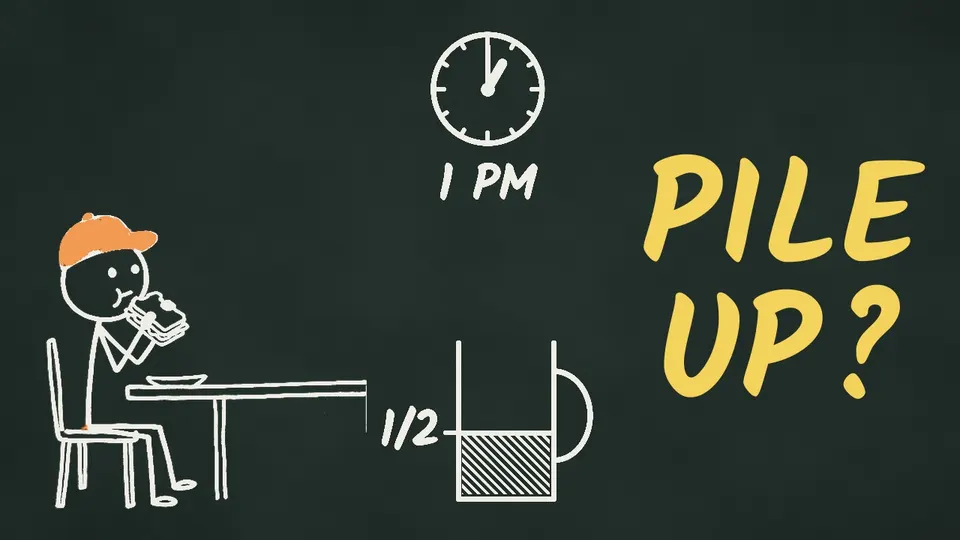
In a typical adult, about every five hours half of the caffeine that's left is gone (people differ a lot: some clear it in two hours, some take twelve). So at lunch, half your 8 AM cup is still in you, and at bedtime an eighth. By the next morning a sliver is left, about four percent, and the next cup lands on top of it. Does it pile up, day after day?
This episode watches the top of each morning. The peaks climb (1, 1.036, 1.037...) and then stall, because the more caffeine is in you, the more you clear overnight, until what you clear is exactly the cup you add. "Looks flat" isn't proof, so the film zooms in and runs a test: give or take a thousandth of a cup, then a millionth, every peak from some morning on stays inside, and only one number passes every tolerance. That number is the limit: a hair over 1.037 cups, one exact number whose decimals never end. The same test gives the lone cup's limit (zero) and a slow clearer's (1⅓ cups). And the question it leaves: can you get a limit straight from the rule, without watching?
Watch the Short of this episode on YouTube
From the film
Where this sits: Calculus 2, the Big Idea of the limit (Stewart, Calculus: Early Transcendentals, §2.2). Before it: Calculus 1, the Big Idea of the derivative. The Deep Dive that takes it further is Calculus 2.1: computing limits (link to follow once it is published).
Sources
- Caffeine leaves by first-order kinetics (a fixed fraction per hour; half every half-life): Institute of Medicine, Caffeine for the Sustainment of Mental Task Performance (2001), ch. 2, p. 27https://www.nationalacademies.org/read/10219/chapter/4
- About 5 hours in the average adult: StatPearls, "Caffeine" (Evans, Richards, Battisti; updated 2024)https://www.ncbi.nlm.nih.gov/books/NBK519490/
- From 2 to 12 hours across people; peak level 30-60 minutes after drinking: Cappelletti et al., "Caffeine: Cognitive and Physical Performance Enhancer or Psychoactive Drug?", Current Neuropharmacology 13 (2015)https://pmc.ncbi.nlm.nih.gov/articles/PMC4462044/
- A sip from a cup is about 20-25 ml: Lawless, Bender, Oman & Pelletier, "Gender, age, vessel size, cup vs. straw sipping, and sequence effects on sip volume", Dysphagia 18 (2003)https://pubmed.ncbi.nlm.nih.gov/14506985/
- Every other number in the film is computed from the halving rule (a 5-hour half-life, the cup counted at 8 AM; a 12-hour half-life for the slow clearer) and checked in the project's check script. The rule is a model: real caffeine comes in molecules, so the last one is gone in about two weeks, and counting the cup all at once makes each peak a slight overestimate, so "never more than one cup and a sip" holds either way.
The drawings are made with generative AI and drawn on stroke by stroke; the graphs are plotted from the rule by code. The narration is a synthetic voice.