The Power Rule: Why the Power Comes Down
Multiply out the rise, (x + h)ⁿ − xⁿ, and every term but one carries an extra h; the limit keeps only n·xⁿ⁻¹.
Chapters
- Why is the slope of x³ three x²?
- A slope at one point: the derivative
- The question, and a cube that grows: seven pieces
- Rise over run: one h comes off every piece
- Check it at x = 2
- x⁴: count, don't draw
- Any power n: n pieces with one h
- Divide by h, then the limit
- The power rule, and d/dx
- x¹⁰⁰: 101 terms, and the slope is the second
- Past whole numbers: the square root
- The one sentence, and what's next
Calculus 1.2: The power rule, the companion
Wait, That's It? · the notebook for "The Power Rule: Why the Power Comes Down | Calculus 1.2"
The episode in one sentence: multiply out the rise, , and every term but one carries an extra ; the limit keeps only .
Where this sits: Calculus 1.2, the power rule (Stewart, Calculus: Early Transcendentals, §3.1). It uses one thing from Calculus 1.1: the slope at a point is where rise over run heads as the gap shrinks to zero.
How to use it: run the first code cell (Shift + Enter, or Runtime → Run all), then drag the sliders. In order:
- Play: grow the cube and watch the three shares of the slope; check it at 2; count the picks for any ; then the square root.
- FAQ: the questions students ask about this section.
- Practice: five textbook-style problems, easiest first, answers hidden until you click.
- One open question to think about.
- Optional side trips: Pascal's triangle, a real one-liter cube, and where the other powers get proved.
1. Play
Grow the cube
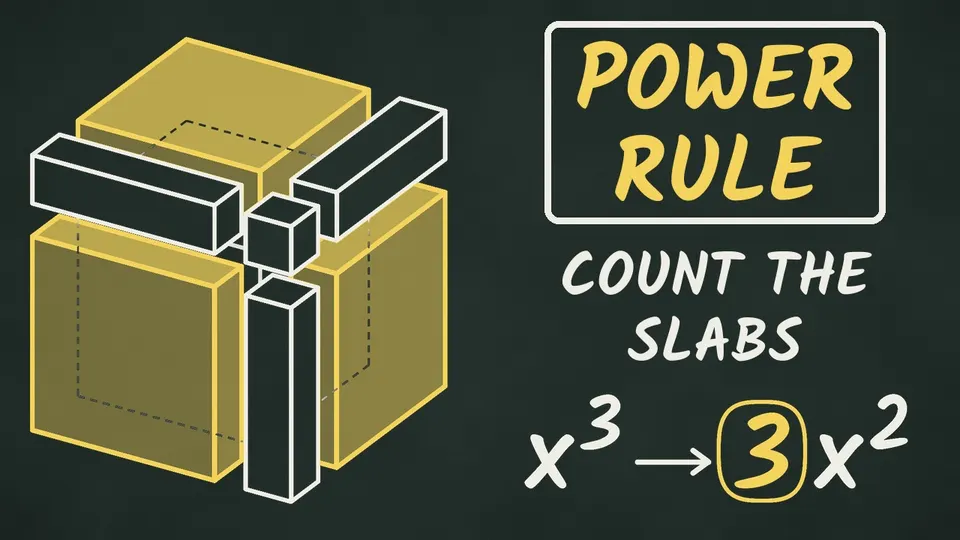
A cube of side has volume . Step the gap: every side grows to . The new cube is the old one plus seven pieces: three slabs (, yellow), three rods (, orange) and one corner (, chalk).
The rise is those seven pieces: . Divide by the run, , and one comes off every piece:
Drag the gap toward 0. The slabs' share never moves; the other two shrink with .
3 slabs (yellow), 3 rods (orange), 1 corner, around the old cube
- slope
- 15.2500
Check it at 2
At the rule says . Here is rise over run on for three gaps, with each kind's share. The slabs give the 12 every time: it is the term that had exactly one before the division.
| gap h | slabs 3x² | rods 3xh | corner h² | rise over run |
|---|---|---|---|---|
| 0.1 | 12 | 0.6 | 0.01 | 12.61 |
| 0.01 | 12 | 0.06 | 0.0001 | 12.0601 |
| 0.001 | 12 | 0.006 | 0.000001 | 12.006001 |
Predict, then reveal
Now at the same point, . Nobody can draw the four-dimensional cube, but you can still count. Before you run the next cell, write down the number you think rise over run heads for. Then run it.
Show the answer
| gap h | rise over run on y = x⁴ at 2 |
|---|---|
| 0.1 | 34.481 |
| 0.01 | 32.240801 |
| 0.001 | 32.024008001 |
It heads for . is four factors. A piece with exactly one takes its from factor 1, 2, 3 or 4 and from the other three: four pieces, each , together . Divide by : . Everything else still carries an and shrinks away:
At that is : 34.481, 32.240801, 32.024008001.
Count the picks, for any n
is factors. Each piece of the product takes one letter from every factor: or . The cell below lists every way of picking and sorts the pieces by how many 's they took.
- No : one piece, (the old one; the rise takes it away).
- Exactly one : pieces, one for each factor the can come from. Together: .
- Two or more 's: every other piece. After dividing by they still carry an .
Drag . The yellow bar is always .
- pieces of (x + h)3
- 8
- with exactly one h
- 3
the pieces with one h: x·x·h, x·h·x, h·x·x
Rise over run against the rule
The same triangle as Calculus 1.1, on at . Pick a power, then drag the gap down. Rise over run (the yellow line's slope) heads for .
- n·xn−1 at x = 1.2
- 4.3200
- rise over run
- 6.3700
Past whole numbers: the square root
. There is no "half a factor", so the counting argument says nothing here. The rule still works (its proof comes later in the course): bring the down and subtract one from the power,
Check it the honest way: rise over run from , with the gap shrinking.
- the rule
- 0.25
- rise over run
- 0.2153
| gap | rise over run |
|---|---|
| 0.1 | 0.2485 |
| 0.01 | 0.2498 |
| 0.0001 | 0.2500 |
2. FAQ: where students get stuck
- Why does multiplying brackets out mean "pick one letter from each"?
- Where did go before we divided by ?
- Why does only the term with one survive? And why can't just be zero?
- Is a "piece" the same as a "term"?
- "The slope is the second." The second what?
- Why is one half? And why does the rule work for with no "half a factor"?
- What is , and how is it different from ?
- Do I have to multiply out every time? What about or ?
1. Why does multiplying brackets out mean "pick one letter from each"?
That is all multiplying out ever is. Take two brackets: . Each of the four pieces took one letter from the first bracket and one from the second, and every way of choosing shows up once. The was picked once in two of them ( and ): that is Calculus 1.1's . With three brackets there are pieces, and on the cube each bracket is a direction: pick and the piece is thick that way, pick and it is thin. With brackets nothing changes but the count.
2. Where did go before we divided by ?
The rise is the new height minus the old one: . The piece with no at all is , so the subtraction removes it. (On the cube: the new cube minus the old cube leaves the seven pieces.) Only then do we divide by . If were still there, would blow up as shrinks.
3. Why does only the term with one survive? And why can't just be zero?
Dividing by takes one off every term. The term that had exactly one is left with none: . A term that had two or more still carries an , so it shrinks to zero when does. That is what the one sentence means by an "extra" : extra beyond the one the division removes. And can't be zero while you divide: rise over run would be . You divide while is still a gap, then let it shrink (the limit of Calculus 1.1).
4. Is a "piece" the same as a "term"?
A piece is one product of picks, like : one chunk of the cube. A term is the like pieces added up: three slabs make the term . The number in front of a term counts its pieces.
5. "The slope is the second." The second what?
The second term. multiplied out has 101 terms, from to . The first is taken away by the subtraction; the second is , the one with exactly one ; divide by and it is , the slope. The other 99 terms still carry an and vanish in the limit.
6. Why is one half? And why does the rule work for with no "half a factor"?
Two school rules for exponents: a power of is a square root, and a minus sign in the exponent means "one over". So . For the rule says: bring down, and , so the slope is ; at 4 that is . The counting proof in the film only covers For other powers the same formula is true, but it needs a different proof, later in the course. Until then the numbers back it up: rise over run at 4 reads 0.2485, 0.2498, … heading for 0.25.
7. What is , and how is it different from ?
is an instruction: "take the derivative of what follows". . If you name the curve , then of is written : Calculus 1.1's notation, the same thing with the put in.
8. Do I have to multiply out every time? What about or ?
No: that is the point of a rule. You proved it once; now in one line. And you never needed the whole expansion, only its first two terms. Constants in front and sums (, ) come with the next rules, in Calculus 3.
3. Practice
Five problems in the textbook's notation, easiest first. Try each on paper, then click to check.
Problem 1.
Find (a) and (b) .
Show the answer
- (a) The power rule with : the 7 comes down in front, and the power drops by one: .
- (b) , so : (any nonzero number to the power 0 is 1). It makes sense: is a straight line that climbs one for every one across, so its slope is 1 everywhere.
Problem 2.
A square of side has area . Its side grows to . Name the pieces the square gains, write the rise, and find the slope of from them.
Show the answer
- The grown square is the old square plus two strips, each by , and one small corner, by .
- Rise: .
- Divide by the run (not zero): . The strips had one , so none is left; the corner still has one.
- Let shrink: . The 2 in counts the strips, as the 3 in counts the slabs.
Problem 3.
Find the slope of at .
Show the answer
- Write the root as a power: .
- The power rule: (bring the down; ; a negative power means "one over").
- At : .
Problem 4.
Find the slope of at .
Show the answer
- Write it as a power: .
- The power rule with : .
- At : . Negative, because goes downhill as grows.
Problem 5.
Use the definition (rise over run, then the limit) to find the slope of . One line a step.
Show the answer
- Multiply out: (one piece with no , four with one, six with two, four with three, one with four: 16 pieces).
- Rise: (the subtraction removes ).
- Divide by , which is not zero: .
- Let : every term but the first still carries an , so the limit is .
4. One open question
At the point on the slope is . Zoom in on the curve there and it looks like a straight line. Which line? What is its equation, and how far from the curve is it at ? (That is Calculus 1.3.)
Optional: all the coefficients (Pascal's triangle)
A side trip: the film needs only the first two terms of . Here are all of them.
The number of pieces with exactly 's is the number of ways to choose which of the factors give their . Row below lists those counts for . The second entry of every row is : the power that comes down.
| n = 0: | 1 | |||||||
|---|---|---|---|---|---|---|---|---|
| n = 1: | 1 | 1 | ||||||
| n = 2: | 1 | 2 | 1 | |||||
| n = 3: | 1 | 3 | 3 | 1 | ||||
| n = 4: | 1 | 4 | 6 | 4 | 1 | |||
| n = 5: | 1 | 5 | 10 | 10 | 5 | 1 | ||
| n = 6: | 1 | 6 | 15 | 20 | 15 | 6 | 1 | |
| n = 7: | 1 | 7 | 21 | 35 | 35 | 21 | 7 | 1 |
Optional: a real cube, one liter
A side trip into a use: how good is the rule's estimate for a real, small change?
A cube 10 cm on a side holds exactly one liter (1,000 cm³). Make every side a millimeter longer. The slope of at 10 is cm³ per cm, so a gap of 0.1 cm should add about cm³. The true gain is a little more, by exactly the rods and the corner.
| the rule’s estimate, 3·x²·h: | 30.0 cm³ |
|---|---|
| the true gain, (x + h)³ − x³: | 30.301 cm³ |
| slabs | 30.0 |
| rods | 0.3 |
| corner | 0.001 |
Optional: where the other powers get proved
A side trip: a map, not a proof.
The counting argument needs factors, so it proves the rule for only. The film uses the rule for and names , with "proofs: Calculus 3, 4" on the board:
- Negative whole powers (, , …) follow from the quotient rule, in Calculus 3.
- Fractional powers (, , …) follow from the chain rule and implicit differentiation, in Calculus 4.
In every case the formula is the same: .
From the film
Where this sits, in order: Calculus 1, the Big Idea (what a derivative is) https://youtu.be/ZBqtb7uhrkI then Calculus 1.1, the limit https://youtu.be/hPWb3ZwGbhk then Calculus 1.2, the power rule (this part), then Calculus 1.3, the tangent line. Playlist DEEP DIVE: Calculus.
Textbook: James Stewart, Calculus: Early Transcendentals, 9th ed., §3.1 (Derivatives of Polynomials and Exponential Functions).
Next: at the point (3, 9) on y = x² the slope is 6. Zoom in, and the curve looks like a line. Which line? That is Calculus 1.3.
Sources
- The power rule for a positive whole number n, proved by multiplying out (x + h)ⁿ ("All other terms contain powers of h that are two or greater"), and the note that it is extended later to negative and then to rational powers: OpenStax, Calculus Volume 1, §3.3 Differentiation Rules (Theorem 3.3, The Power Rule, and its proof).https://openstax.org/books/calculus-volume-1/pages/3-3-differentiation-rules
- The method (a gap h, rise over run, the limit) and x² turning into 2x: Calculus 1.1, linked above.
- What is proved here: the rule for n = 1, 2, 3, and every whole number after. For the square root and for negative powers the rule is stated and checked in numbers; the board says where the proofs come (Calculus 3 and 4).
- Every equation and number on screen is checked with SymPy in the project's check scripts.
The student is drawn with generative AI; the cube, the graphs and the equations are made by code. The narration is a synthetic voice.