The Limit: Is the Slope 6, or Nothing?
The derivative isn't the slope of any chord; it's the number the chord slopes head for, found by doing the algebra while the gap is still not zero.
Chapters
- Last time: close, but never met
- Is the slope 6, or nothing?
- Any second point
- The hole at 3, and the limit
- Every point at once: the triangle at any x
- The algebra, while h is still a gap
- Back at 3: the pattern, proved
- Close enough, every time: epsilon and delta
- Secant to tangent: Cauchy's definition
- f′(x), also written dy/dx
- Back to Bolt: the exact answer, and what's next
Calculus 1.1: From slope to limit, the companion
Wait, That's It? · the notebook for "Is the Slope 6, or Nothing? The Limit | Calculus 1.1"
The episode in one sentence: the derivative isn't the slope of any chord; it's the number the chord slopes head for, found by doing the algebra while the gap is still not zero.
Where this sits: Calculus 1.1, the limit and the definition of the derivative (Stewart, Calculus: Early Transcendentals, §2.2 and §2.7).
How to use it: run the first code cell (Shift + Enter, or Runtime → Run all), then drag the sliders. In order:
- Play: slide the chord in from both sides, predict a slope, then poke the hole of .
- FAQ: the questions students ask about this section.
- Practice: four textbook-style problems, easiest first, answers hidden until you click.
- One open question to think about.
- Optional side trips: the formal ε–δ statement, and why a computer can't just use a tiny gap.
1. Play
The chord, from both sides
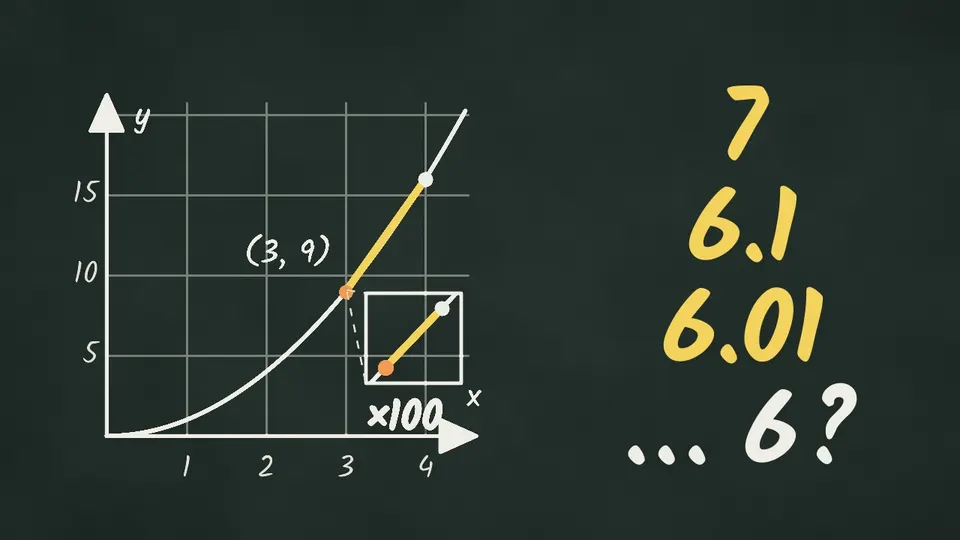
A chord through and a second point on . The run (orange) is the gap ; the rise (yellow) is the second height minus the first. Drag the gap toward 0 from the right, then from the left. Every chord's slope is exactly : close to 6, never 6. At there is no chord at all.
The right panel zooms in with the gap, as the film's magnifier does: at a gap of 0.001 the two points are too close to tell apart on the left, but the zoomed view still shows them apart, and the chord all but on the curve.
- gap h
- +1.000
- zoom
- ×1
- slope = 6 + h
- 7.000
Predict, then reveal
On the same curve , take the point at instead. Before you run the next cell, write down the number you think the chord slopes head for as the gap shrinks. Then run it.
Show the answer
| gap h | chord slope |
|---|---|
| +0.100 | −3.9000 |
| +0.010 | −3.9900 |
| +0.001 | −3.9990 |
| −0.001 | −4.0010 |
| −0.010 | −4.0100 |
| −0.100 | −4.1000 |
The slopes are , so from both sides they head for . That is at : the same algebra as the episode's, while , which heads for . A negative number makes sense: at the parabola is going downhill.
The hole
is the chord slope from 3 to (it is the episode's fraction with ). Away from 3 it equals , a straight line. At it is : no value, a hollow point. Drag toward 3 from either side and watch the value.
- x
- 2.50
- (x² − 9)/(x − 3)
- 5.50
2. FAQ: where students get stuck
- Isn't the limit just plugging in?
- Why can't be zero?
- Can we even divide by ?
- But the slopes never reach 6?
- Does the limit have to equal the value at the point?
- Is a fraction?
1. Isn't the limit just plugging in?
Often it gives the same number, which is why it feels that way: plug 3 into and you get 6. But the limit never uses the value at 3. It asks where the values head as comes close. For , plugging in gives , no number, while the limit is 6. The derivative is always this case: at the chord's slope is , so plugging in can never give it.
2. Why can't be zero?
A chord needs two points. At the two points are one: rise 0, run 0, and is not a number. So the algebra is done while , and only the simplified answer, , which no longer divides by , is asked where it heads as .
3. Can we even divide by ?
Yes, because is not zero while we do it. is true for every . The limit then asks about near 0, never at 0. (This is the student's question in the episode.)
4. But the slopes never reach 6?
They don't need to. "The limit is 6" means the slopes come within any tolerance of 6 you name, for every gap that is small enough: within 0.1 of 6 for every gap within ±0.1, within 0.05 for every gap within ±0.05, and so on for any tolerance, because the slope is off from 6 by exactly the gap. No other number passes every tolerance. That is the ε–δ definition; see the Optional section, and Calculus 2.2.
5. Does the limit have to equal the value at the point?
No. has no value at 3, and its limit there is 6. Even a function defined as everywhere except has limit 6 at 3: the limit ignores the point itself. When the limit does equal the value, the function is called continuous there (Stewart §2.5, Calculus 2.3).
6. Is a fraction?
Not as written: and are not numbers here. is the limit of a real fraction, , the rise over the run, and the notation keeps the shape of the fraction it came from. That shape is why some rules look like fraction arithmetic (you'll see it in the chain rule), but the derivative itself is one number for each .
3. Practice
Four problems in the textbook's notation, easiest first. Try each on paper, then click to check.
Problem 1.
Find .
Show the answer
- Plugging in gives , so plugging in doesn't answer it.
- Factor the top: (a difference of squares).
- For , cancel the common factor: . Cancelling is allowed because there, and the limit only looks at .
- heads for as .
Problem 2.
Let for and for (no value at 2). Find and . Does exist?
Show the answer
- From the left, , so , which heads for . So .
- From the right, , so , which heads for . So .
- The two one-sided limits differ (), so the two-sided limit does not exist. (In the episode both sides gave 6, which is why the limit at 3 was 6.)
Problem 3.
Let . Find from the definition .
Show the answer
- The second height: (multiply out the square).
- The rise: (the and cancel).
- Over the run, while : (divide each term by , allowed since ).
- Let : heads for .
Check: at the slope is 3, the slope of the part alone, since is flat at 0.
Problem 4.
Let . Find from the definition, for .
Show the answer
- The rise: (common denominator ).
- Over the run, while : (the cancels, allowed since ).
- Let : heads for , so the slope heads for (fine for ).
Check: the slope is negative everywhere, and does go downhill on both sides of 0. At it is .
4. One open question
For , . Do the same triangle on : what does become while , and what does it head for? Then try . Is there a pattern that would give you without multiplying anything out? (That is Calculus 1.2.)
Optional: the formal statement (epsilon and delta)
A side trip: the precise definition gets an episode of its own, Calculus 2.2 (Stewart §2.4). Here is just the statement, on this episode's picture.
means: for every there is a such that implies .
Here , so : the slope is off from 6 by exactly the gap. So always works. Drag the tolerance: the yellow band is , the orange strip is the gaps with , and the line inside the strip always stays inside the band.
- ε
- 0.50
- δ = ε
- 0.50
every 0 < |h| < δ lands inside 6 ± ε
Optional: why a computer can't just use a tiny gap
A side trip into how computers store numbers; nothing in the episode depends on it.
If the limit is where the slopes head for tiny gaps, why not let a computer try ? Because a computer keeps about 16 significant digits. At the gap is lost entirely: the computer stores 3, the rise comes out 0, and the "slope" is 0. Even well before that, the rise is a tiny difference of two nearly equal numbers and loses digits. Run the cell: the error falls as the gap shrinks, then climbs again.
| gap h | slope | error |
|---|---|---|
| 1e-1 | 6.100000000000 | 1.0e-01 |
| 1e-2 | 6.010000000000 | 1.0e-02 |
| 1e-3 | 6.000999999999 | 1.0e-03 |
| 1e-4 | 6.000100000012 | 1.0e-04 |
| 1e-5 | 6.000009999951 | 1.0e-05 |
| 1e-6 | 6.000001000928 | 1.0e-06 |
| 1e-7 | 6.000000087880 | 8.8e-08 |
| 1e-8 | 5.999999963535 | 3.6e-08 |
| 1e-9 | 6.000000496442 | 5.0e-07 |
| 1e-10 | 6.000000496442 | 5.0e-07 |
| 1e-11 | 6.000000496442 | 5.0e-07 |
| 1e-12 | 6.000533403494 | 5.3e-04 |
| 1e-13 | 6.004086117173 | 4.1e-03 |
| 1e-14 | 6.217248937901 | 2.2e-01 |
| 1e-15 | 5.329070518201 | 6.7e-01 |
| 1e-16 | 0.000000000000 | 6.0e+00 |
The algebra avoids all of this: exactly, for every , and heads for 6. The limit is found by algebra, not by a very small number.
From the film
Where this sits: Calculus 1.1, the Deep Dive after Calculus 1 (Big Idea): https://youtu.be/ZBqtb7uhrkI
Textbook: James Stewart, Calculus: Early Transcendentals, 9th ed., §2.2 (The Limit of a Function) and §2.7 (Derivatives and Rates of Change).
Next: Calculus 1.2, the power rule.
Sources
- Augustin-Louis Cauchy, Résumé des leçons … sur le calcul infinitésimal (1823): the derivative defined as the limit of [f(x+i) − f(x)]/i as i → 0. Judith V. Grabiner, "The Origins of Cauchy's Theory of the Derivative", Historia Mathematica 5 (1978) 379–409https://legacy-www.math.harvard.edu/~knill/teaching/summer2014/exhibits/lagrange/grabiner.pdf
- The notation f′(x) and dy/dx: Goodfellow, Bengio & Courville, Deep Learning (MIT Press, 2016), chapter 4https://www.deeplearningbook.org/contents/numerical.html
- Usain Bolt's race (Berlin 2009): the 10 m splits (Table A) and his top speed, 12.34 m/s at 67.90 m (Table D): Graubner & Nixdorf, New Studies in Athletics 26:1/2 (2011)https://worldathletics.org/download/downloadnsa?filename=31514203-6724-455e-906c-ef931384c656.pdf&urlslug=biomechanical-analysis-of-the-sprint-and-hurd
- The race curve is drawn through the report's splits; it passes 68 m at 6.93 s. Every equation and number on screen is checked with SymPy and SciPy in the project's check scripts.
The drawings are made with generative AI and drawn on stroke by stroke; the graphs and equations are made by code. The narration is a synthetic voice.